Florida inspectors made 260 visits to Kissimmee food businesses from July 7 to Oct. 8, 2026; 199 closed with no further action. How to look one up.
Last checked Oct. 9, 2026. Figures come from the Florida Department of Business and Professional Regulation’s public food inspection files, District 4, downloaded Oct. 9, 2026. They cover inspections from July 7 to Oct. 8, 2026, at licensed food businesses with a Kissimmee address in ZIP codes 34741, 34743 and 34744, the ZIP codes that cover the city. Those ZIP codes also take in some homes and businesses outside city limits.
Florida does not give restaurants a score or a letter grade. The state’s Division of Hotels and Restaurants inspects licensed restaurants and records what the inspector found and what happened next. Osceola County does not run its own restaurant inspections. To check a particular restaurant, search the DBPR online inspection search by name or license number.
Who to call
- DBPR Customer Contact Center: 850-487-1395 (TTY 800-955-8771)
- Division of Hotels and Restaurants email: dhr.info@myfloridalicense.com
- Report a problem: file a complaint online with DBPR
- Food poisoning emergency: 911
How Kissimmee inspections turned out
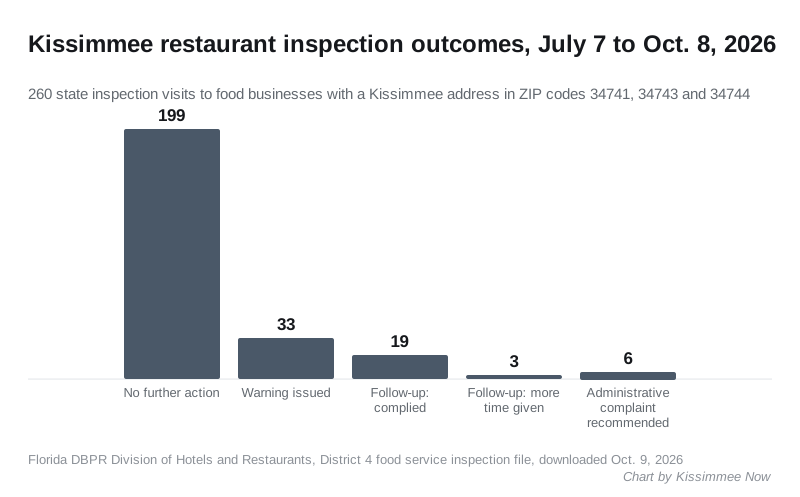
State inspectors made 260 inspection visits to 232 licensed food businesses in those three months. Most were routine inspections (231). The rest were complaint inspections (13) and licensing inspections for new businesses (16).
| Outcome recorded by DBPR | Visits |
|---|---|
| Inspection completed, no further action | 199 |
| Warning issued | 33 |
| Follow-up visit: business complied | 19 |
| Follow-up visit: more time given, pending | 3 |
| Administrative complaint recommended (including one at a follow-up visit) | 6 |
| Emergency order recommended | 0 |
On routine inspections, the median number of violations recorded was four, and the median number of high priority violations was zero. Of the 231 routine inspections, 129 recorded no high priority violation.
These counts describe inspections, not restaurants. One restaurant can appear more than once if inspectors returned to check that problems were fixed. Across all of Osceola County, the file lists 627 visits in the same period, including one emergency order recommendation at a business outside these three ZIP codes.
What the outcomes mean
DBPR records one of a set of outcomes after each visit:
- No further action: the inspection is complete. The restaurant may still have had violations that were corrected on the spot or that do not call for a return visit.
- Warning issued: violations were found and the inspector will come back to check they were fixed by a set date.
- Follow-up visit, complied: the inspector returned and found the problems corrected.
- Follow-up visit, extension given: the business was given more time to fix something.
- Administrative complaint recommended: the inspector referred the case for possible formal action by the state. A recommendation is not a finding.
- Emergency order recommended: the inspector found conditions serious enough to recommend closing the business until they are corrected.
How violations are graded
Florida sorts violations into three levels:
- High priority: could directly contribute to foodborne illness or injury, such as food held at the wrong temperature or employees not washing hands.
- Intermediate: could lead to a high priority problem if not corrected, such as missing food safety training records.
- Basic: good practice items, such as cleanliness of floors and walls.
A long list of basic violations can look worse on paper than one high priority problem that was fixed at once. Read the inspection detail, not just the count.
Method
We downloaded DBPR’s District 4 food service inspection extract, which lists every inspection from July 1, 2026, and kept rows where the business’s city is Kissimmee and its ZIP code is 34741, 34743 or 34744. Restaurants on the U.S. 192 tourist corridor west of the city, in ZIP codes 34746 and 34747, are not counted here, even though their address says Kissimmee. Medians are of all routine inspections. We do not name individual restaurants on this page: one inspection is a snapshot of one day, and the state’s own search gives the full record.
What this means for you
- Search a restaurant on the state’s site before you book a party there.
- Saw something wrong? File a DBPR complaint; it can trigger a visit.
- Remember: no further action does not mean no violations.
Related: new businesses in Kissimmee, things to do this month and who to call at City Hall.
Frequently asked questions
How do I check a restaurant’s inspection in Kissimmee?
Search the Florida Department of Business and Professional Regulation’s online license and inspection search by the restaurant’s name or license number. The state, not the county, inspects restaurants in Florida.
Do Florida restaurants get a letter grade?
No. Florida does not give restaurants a score or letter grade. Inspectors record the violations they find and an outcome, such as no further action or a warning.
Who inspects restaurants in Osceola County?
The Division of Hotels and Restaurants of the Florida Department of Business and Professional Regulation. Osceola County is in its District 4.
How do I report a restaurant in Kissimmee?
File a complaint online with DBPR or call its Customer Contact Center at 850-487-1395. A complaint can lead to an inspection.
Have your say